


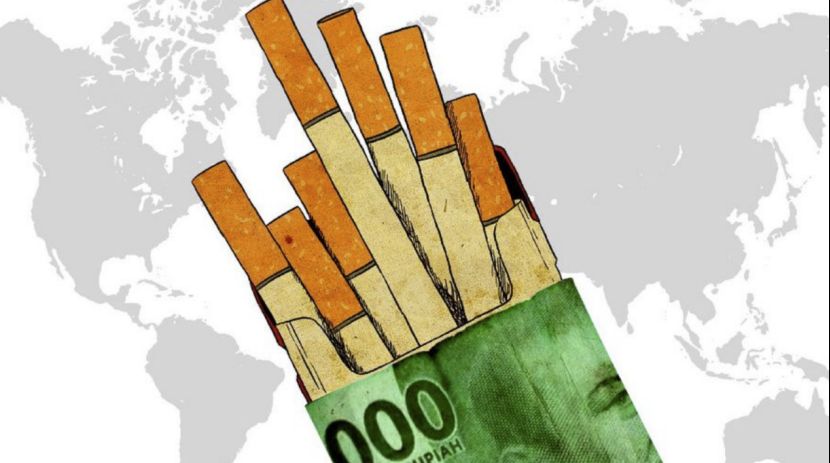
 In 2025, Indonesia's cigarette industry showed an overall weak performance, with both production and sales slumping. Annual production reached 307.8 billion sticks, down 3% year-on-year, the lowest in a decade since 2016. December monthly production was 29 billion sticks, up 3.8% month-on-month but still down sharply by 15.9% year-on-year.
Historically, December usually sees increased production due to rising year-end demand and expectations of a consumption tax hike the following year. However, since excise taxes were not raised in 2026, manufacturers no longer needed to stockpile cheaper tax-band products in advance, which directly affected the production rhythm.
One of the important reasons for the decline in production is weakening purchasing power. From early to mid-2025, weak purchasing power became a nationwide issue, with four consecutive months of deflation from January to August, and overall retail sales weakening. Central bank data shows that real sales of food, beverages, and tobacco fell month-on-month for five consecutive months from January to September.
Affected by this, the Minister of Finance did not raise tobacco excise taxes (CHT) in 2025, only adjusting retail prices. This is the third time in 15 years that excise taxes were not raised, following 2014 (transition period for regional tobacco taxes) and 2019 (economic slowdown plus election year).
In 2026, the government continues to keep excise taxes unchanged, with policy objectives including:• Maintaining people's purchasing power • Alleviating economic pressure • Curbing the circulation of illegal cigarettes Excessively high tax rates can easily backfire, driving consumers toward cheaper illegal cigarettes, further hurting the legitimate tobacco industry and tobacco farmers. Against the backdrop of uneven economic recovery, price increases through tobacco control could further suppress household consumption. Therefore, the suspension of excise tax hikes is seen as a pragmatic choice to stabilize the purchasing power of low- and middle-income groups while squeezing the space for illegal cigarettes. Although public health advocates call for stricter tobacco control, many economists believe this approach is feasible under the current environment.
Extreme tax increases not only struggle to effectively boost fiscal revenue but also hurt the real economy from industry and employment to farmers' incomes. In 2025, the government continued its crackdown on illegal cigarettes, conducting 20,537 inspections and seizing 1.4 billion illegal cigarettes, a 77.3% increase year-on-year, becoming an important measure to protect legitimate producers.
Overall, the downturn in the cigarette industry in 2025 reflects the multiple pressures of weak purchasing power, cautious policy direction, and intensified competition from illegal cigarettes. Maintaining the tax policy unchanged in 2026 is a reflection of the government's search for balance between fiscal, economic, and social goals.
In 2025, Indonesia's cigarette industry showed an overall weak performance, with both production and sales slumping. Annual production reached 307.8 billion sticks, down 3% year-on-year, the lowest in a decade since 2016. December monthly production was 29 billion sticks, up 3.8% month-on-month but still down sharply by 15.9% year-on-year.
Historically, December usually sees increased production due to rising year-end demand and expectations of a consumption tax hike the following year. However, since excise taxes were not raised in 2026, manufacturers no longer needed to stockpile cheaper tax-band products in advance, which directly affected the production rhythm.
One of the important reasons for the decline in production is weakening purchasing power. From early to mid-2025, weak purchasing power became a nationwide issue, with four consecutive months of deflation from January to August, and overall retail sales weakening. Central bank data shows that real sales of food, beverages, and tobacco fell month-on-month for five consecutive months from January to September.
Affected by this, the Minister of Finance did not raise tobacco excise taxes (CHT) in 2025, only adjusting retail prices. This is the third time in 15 years that excise taxes were not raised, following 2014 (transition period for regional tobacco taxes) and 2019 (economic slowdown plus election year).
In 2026, the government continues to keep excise taxes unchanged, with policy objectives including:• Maintaining people's purchasing power • Alleviating economic pressure • Curbing the circulation of illegal cigarettes Excessively high tax rates can easily backfire, driving consumers toward cheaper illegal cigarettes, further hurting the legitimate tobacco industry and tobacco farmers. Against the backdrop of uneven economic recovery, price increases through tobacco control could further suppress household consumption. Therefore, the suspension of excise tax hikes is seen as a pragmatic choice to stabilize the purchasing power of low- and middle-income groups while squeezing the space for illegal cigarettes. Although public health advocates call for stricter tobacco control, many economists believe this approach is feasible under the current environment.
Extreme tax increases not only struggle to effectively boost fiscal revenue but also hurt the real economy from industry and employment to farmers' incomes. In 2025, the government continued its crackdown on illegal cigarettes, conducting 20,537 inspections and seizing 1.4 billion illegal cigarettes, a 77.3% increase year-on-year, becoming an important measure to protect legitimate producers.
Overall, the downturn in the cigarette industry in 2025 reflects the multiple pressures of weak purchasing power, cautious policy direction, and intensified competition from illegal cigarettes. Maintaining the tax policy unchanged in 2026 is a reflection of the government's search for balance between fiscal, economic, and social goals.
In 2025, Indonesia's cigarette industry showed an overall weak performance, with both production and sales slumping. Annual production reached 307.8 billion sticks, down 3% year-on-year, the lowest in a decade since 2016. December monthly production was 29 billion sticks, up 3.8% month-on-month but still down sharply by 15.9% year-on-year.
Historically, December usually sees increased production due to rising year-end demand and expectations of a consumption tax hike the following year. However, since excise taxes were not raised in 2026, manufacturers no longer needed to stockpile cheaper tax-band products in advance, which directly affected the production rhythm.
One of the important reasons for the decline in production is weakening purchasing power. From early to mid-2025, weak purchasing power became a nationwide issue, with four consecutive months of deflation from January to August, and overall retail sales weakening. Central bank data shows that real sales of food, beverages, and tobacco fell month-on-month for five consecutive months from January to September.
Affected by this, the Minister of Finance did not raise tobacco excise taxes (CHT) in 2025, only adjusting retail prices. This is the third time in 15 years that excise taxes were not raised, following 2014 (transition period for regional tobacco taxes) and 2019 (economic slowdown plus election year).
In 2026, the government continues to keep excise taxes unchanged, with policy objectives including:• Maintaining people's purchasing power • Alleviating economic pressure • Curbing the circulation of illegal cigarettes Excessively high tax rates can easily backfire, driving consumers toward cheaper illegal cigarettes, further hurting the legitimate tobacco industry and tobacco farmers. Against the backdrop of uneven economic recovery, price increases through tobacco control could further suppress household consumption. Therefore, the suspension of excise tax hikes is seen as a pragmatic choice to stabilize the purchasing power of low- and middle-income groups while squeezing the space for illegal cigarettes. Although public health advocates call for stricter tobacco control, many economists believe this approach is feasible under the current environment.
Extreme tax increases not only struggle to effectively boost fiscal revenue but also hurt the real economy from industry and employment to farmers' incomes. In 2025, the government continued its crackdown on illegal cigarettes, conducting 20,537 inspections and seizing 1.4 billion illegal cigarettes, a 77.3% increase year-on-year, becoming an important measure to protect legitimate producers.
Overall, the downturn in the cigarette industry in 2025 reflects the multiple pressures of weak purchasing power, cautious policy direction, and intensified competition from illegal cigarettes. Maintaining the tax policy unchanged in 2026 is a reflection of the government's search for balance between fiscal, economic, and social goals.
In 2025, Indonesia's cigarette industry showed an overall weak performance, with both production and sales slumping. Annual production reached 307.8 billion sticks, down 3% year-on-year, the lowest in a decade since 2016. December monthly production was 29 billion sticks, up 3.8% month-on-month but still down sharply by 15.9% year-on-year.
Historically, December usually sees increased production due to rising year-end demand and expectations of a consumption tax hike the following year. However, since excise taxes were not raised in 2026, manufacturers no longer needed to stockpile cheaper tax-band products in advance, which directly affected the production rhythm.
One of the important reasons for the decline in production is weakening purchasing power. From early to mid-2025, weak purchasing power became a nationwide issue, with four consecutive months of deflation from January to August, and overall retail sales weakening. Central bank data shows that real sales of food, beverages, and tobacco fell month-on-month for five consecutive months from January to September.
Affected by this, the Minister of Finance did not raise tobacco excise taxes (CHT) in 2025, only adjusting retail prices. This is the third time in 15 years that excise taxes were not raised, following 2014 (transition period for regional tobacco taxes) and 2019 (economic slowdown plus election year).
In 2026, the government continues to keep excise taxes unchanged, with policy objectives including:• Maintaining people's purchasing power • Alleviating economic pressure • Curbing the circulation of illegal cigarettes Excessively high tax rates can easily backfire, driving consumers toward cheaper illegal cigarettes, further hurting the legitimate tobacco industry and tobacco farmers. Against the backdrop of uneven economic recovery, price increases through tobacco control could further suppress household consumption. Therefore, the suspension of excise tax hikes is seen as a pragmatic choice to stabilize the purchasing power of low- and middle-income groups while squeezing the space for illegal cigarettes. Although public health advocates call for stricter tobacco control, many economists believe this approach is feasible under the current environment.
Extreme tax increases not only struggle to effectively boost fiscal revenue but also hurt the real economy from industry and employment to farmers' incomes. In 2025, the government continued its crackdown on illegal cigarettes, conducting 20,537 inspections and seizing 1.4 billion illegal cigarettes, a 77.3% increase year-on-year, becoming an important measure to protect legitimate producers.
Overall, the downturn in the cigarette industry in 2025 reflects the multiple pressures of weak purchasing power, cautious policy direction, and intensified competition from illegal cigarettes. Maintaining the tax policy unchanged in 2026 is a reflection of the government's search for balance between fiscal, economic, and social goals.