


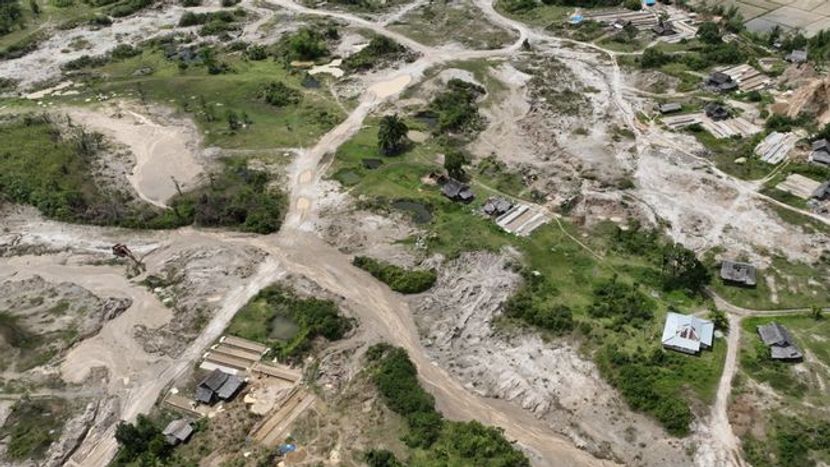
 The Indonesian Nickel Miners Association (APNI) and the Nickel Industry Forum (FINI) have objected to the Ministerial Decree recently issued by the Minister of Energy and Mineral Resources. The decree sets administrative fine standards for mining violations in forest areas, with nickel being the highest at IDR 6.5 billion per hectare per year, far exceeding bauxite (IDR 1.76 billion), tin (IDR 1.25 billion), and coal (IDR 354 million). The associations have sent letters to the President, relevant ministries, and the forest task force, expressing support for forest protection and compliance but arguing that the fines are excessively high, lack fairness and proportionality, could cause uneven treatment among industries, distort the cost structure of the nickel industry, and contradict the principle of equal regulation.
The nickel industry is currently facing international price pressure, narrowing profits, and multiple fiscal burdens (royalties, taxes, non-tax revenues, reclamation obligations, ESG standards, etc.). Unified high nationwide fines would severely squeeze corporate cash flow, potentially delaying investment and production, weakening the industry's ongoing contribution to the state, and could lead to a short-term increase in one-time revenue but a long-term decrease in tax revenue, export earnings, and downstream contributions, ultimately reducing overall state revenue.
The associations recommend adopting a proportional formula to adjust fines, taking into account area, degree and type of damage, duration, economic value, and commodity characteristics, and standardizing fine levels across all minerals to ensure fairness. They also propose converting part of the fines into environmental guarantees, forest restoration funds, geological exploration funds, etc., managed by the state, balancing environmental protection with long-term fiscal revenue.
The Indonesian Nickel Miners Association (APNI) and the Nickel Industry Forum (FINI) have objected to the Ministerial Decree recently issued by the Minister of Energy and Mineral Resources. The decree sets administrative fine standards for mining violations in forest areas, with nickel being the highest at IDR 6.5 billion per hectare per year, far exceeding bauxite (IDR 1.76 billion), tin (IDR 1.25 billion), and coal (IDR 354 million). The associations have sent letters to the President, relevant ministries, and the forest task force, expressing support for forest protection and compliance but arguing that the fines are excessively high, lack fairness and proportionality, could cause uneven treatment among industries, distort the cost structure of the nickel industry, and contradict the principle of equal regulation.
The nickel industry is currently facing international price pressure, narrowing profits, and multiple fiscal burdens (royalties, taxes, non-tax revenues, reclamation obligations, ESG standards, etc.). Unified high nationwide fines would severely squeeze corporate cash flow, potentially delaying investment and production, weakening the industry's ongoing contribution to the state, and could lead to a short-term increase in one-time revenue but a long-term decrease in tax revenue, export earnings, and downstream contributions, ultimately reducing overall state revenue.
The associations recommend adopting a proportional formula to adjust fines, taking into account area, degree and type of damage, duration, economic value, and commodity characteristics, and standardizing fine levels across all minerals to ensure fairness. They also propose converting part of the fines into environmental guarantees, forest restoration funds, geological exploration funds, etc., managed by the state, balancing environmental protection with long-term fiscal revenue.
The Indonesian Nickel Miners Association (APNI) and the Nickel Industry Forum (FINI) have objected to the Ministerial Decree recently issued by the Minister of Energy and Mineral Resources. The decree sets administrative fine standards for mining violations in forest areas, with nickel being the highest at IDR 6.5 billion per hectare per year, far exceeding bauxite (IDR 1.76 billion), tin (IDR 1.25 billion), and coal (IDR 354 million). The associations have sent letters to the President, relevant ministries, and the forest task force, expressing support for forest protection and compliance but arguing that the fines are excessively high, lack fairness and proportionality, could cause uneven treatment among industries, distort the cost structure of the nickel industry, and contradict the principle of equal regulation.
The nickel industry is currently facing international price pressure, narrowing profits, and multiple fiscal burdens (royalties, taxes, non-tax revenues, reclamation obligations, ESG standards, etc.). Unified high nationwide fines would severely squeeze corporate cash flow, potentially delaying investment and production, weakening the industry's ongoing contribution to the state, and could lead to a short-term increase in one-time revenue but a long-term decrease in tax revenue, export earnings, and downstream contributions, ultimately reducing overall state revenue.
The associations recommend adopting a proportional formula to adjust fines, taking into account area, degree and type of damage, duration, economic value, and commodity characteristics, and standardizing fine levels across all minerals to ensure fairness. They also propose converting part of the fines into environmental guarantees, forest restoration funds, geological exploration funds, etc., managed by the state, balancing environmental protection with long-term fiscal revenue.
The Indonesian Nickel Miners Association (APNI) and the Nickel Industry Forum (FINI) have objected to the Ministerial Decree recently issued by the Minister of Energy and Mineral Resources. The decree sets administrative fine standards for mining violations in forest areas, with nickel being the highest at IDR 6.5 billion per hectare per year, far exceeding bauxite (IDR 1.76 billion), tin (IDR 1.25 billion), and coal (IDR 354 million). The associations have sent letters to the President, relevant ministries, and the forest task force, expressing support for forest protection and compliance but arguing that the fines are excessively high, lack fairness and proportionality, could cause uneven treatment among industries, distort the cost structure of the nickel industry, and contradict the principle of equal regulation.
The nickel industry is currently facing international price pressure, narrowing profits, and multiple fiscal burdens (royalties, taxes, non-tax revenues, reclamation obligations, ESG standards, etc.). Unified high nationwide fines would severely squeeze corporate cash flow, potentially delaying investment and production, weakening the industry's ongoing contribution to the state, and could lead to a short-term increase in one-time revenue but a long-term decrease in tax revenue, export earnings, and downstream contributions, ultimately reducing overall state revenue.
The associations recommend adopting a proportional formula to adjust fines, taking into account area, degree and type of damage, duration, economic value, and commodity characteristics, and standardizing fine levels across all minerals to ensure fairness. They also propose converting part of the fines into environmental guarantees, forest restoration funds, geological exploration funds, etc., managed by the state, balancing environmental protection with long-term fiscal revenue.